
And the behaviors everyone points to — bad decisions, short time horizons, resistance to programs — aren’t causes. They’re symptoms of something that has no name in the current vocabulary.
For as long as we have talked about poverty, we have argued over whether it is caused by individual failure or structural barrier. Whether people in poverty make bad decisions or whether the system is rigged against them. Whether the answer is personal responsibility or policy intervention.
Both explanations capture something real. Neither explains why poverty persists so consistently, across so many different individuals, contexts, and intervention designs.
I want to propose a different framing. One that does not require choosing between behavior and structure. One that makes the behaviors legible as structural outputs, not character flaws.
The Missing Variable
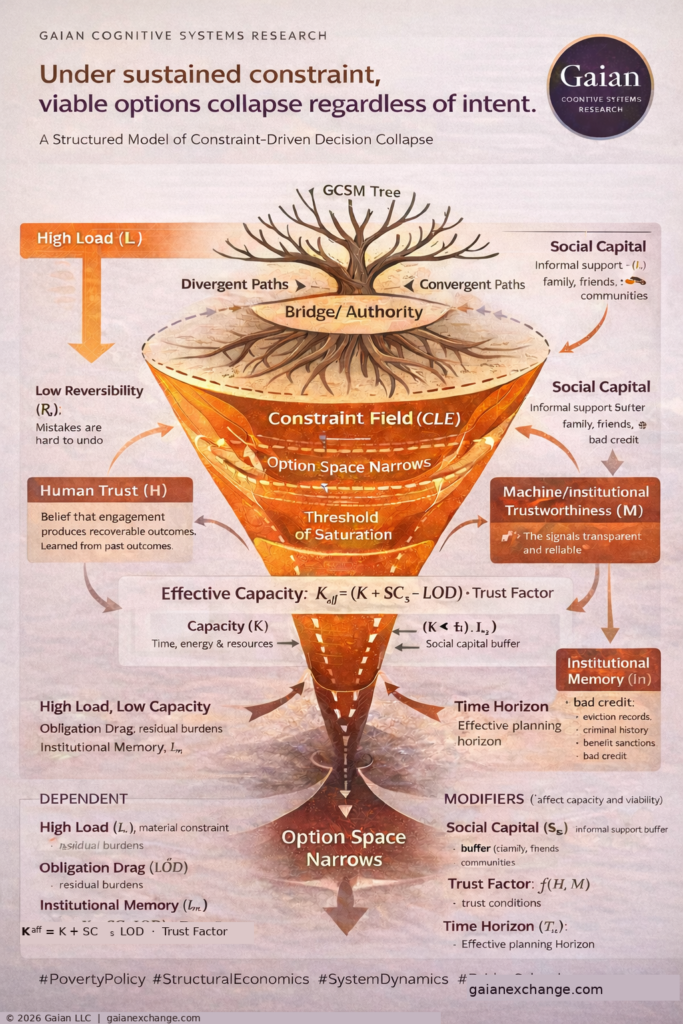
Imagine a tree of possibility. Every path a person could take in their life — jobs, relationships, relocations, education, savings strategies — is a branch. The tree is wide at the top, narrowing as you move through it, because some paths require other paths to have been taken first.
Now imagine a cone of constraint pressing down on that tree. The cone narrows as pressure increases. Load from financial obligations, time scarcity, caregiving demands, health burdens, administrative requirements. As the cone narrows, it prunes branches from the tree.
But here is the critical distinction: it does not prune them from the tree. It prunes them from viability. The branches still exist. They are still theoretically possible. But under current constraint conditions, they cannot be accessed.
This is the core move of the Gaian Cognitive Spectrum Model applied to economics: having options and having viable options are two structurally different conditions. Standard poverty analysis conflates them. That conflation is where most intervention failure begins.
The Two Traps
Poverty has two distinct failure modes. Both operate at the same time in most cases. They require different interventions. Conflating them is the mechanism of policy failure.
The first is the compression trap. It is material. Load exceeds effective capacity. The actions required to reduce load require capacity the system does not have. The actions required to restore capacity require capacity the system does not have. The trap is self-reinforcing: it does not require any new negative event to sustain itself. A person in the compression trap can see options clearly and still be unable to reach them.
The second is the perception trap. It is temporal and signal-based. Under sustained constraint, the effective planning horizon compresses. A person whose life has been unstable for long enough stops being able to evaluate options with long payoff horizons. Not because they lack intelligence. Because planning across a time frame that prior experience has shown is unreliable produces no actionable information. A two-year training program is not rejected. It is not perceived as an option at all.
The compression trap blocks access to visible options. The perception trap removes options from awareness before access is even tested.
Most poverty programs are designed for populations in neither trap. They assume the person can see the option and has the capacity to access it. For the population they are most often offered to, both assumptions are wrong.
Maria
Consider Maria. Single parent, two children. Lost her job eight months ago. Current state: her $2,100 in income support is fully consumed by $1,200 in rent, $600 in food and utilities, and $400 in childcare. She carries $8,400 in medical debt from her younger child’s emergency hospitalization, accruing interest. Her car needs $800 in repairs she cannot afford.
Load is high. Effective capacity is near zero. Two prior program enrollments produced unexpected penalties that reduced her benefits. Her trust in systems has collapsed. Her planning horizon has compressed to the current month.
Now consider what happens when she is offered a job training program.
The program is available. It is structurally possible. But accessing it requires transportation she does not have because the car is broken. It requires childcare during training hours. It requires the emotional capacity to enroll in a new program after being punished by the last two. It requires the ability to imagine a payoff six months out when her planning horizon has compressed to weeks.
She declines. The program is marked as a failure for her. The structural interpretation is that Maria lacks motivation. The accurate interpretation is that the program was inadmissible at her current constraint state. It would have been inadmissible for almost anyone at her position.
The same program offered at the right time, after material stabilization and trust restoration, would have been admissible. The program did not change. Maria’s structural position needed to change first.
The Sequencing Principle
This is why most poverty intervention fails. It is not because the programs are badly designed. It is because they are sequenced incorrectly.
Material stabilization must precede option expansion. Trust restoration must precede program engagement. Horizon extension must precede long-payoff interventions. Reversibility must be preserved throughout, because once it is lost, no subsequent intervention can restore what has become structurally inadmissible.
The correct sequence is: stabilize, then reduce accumulated obligations, then restore trust through consistent predictable system behavior, then reduce switching costs, and only then expand viable options. Each step creates the structural conditions required for the next step to function.
Step 5 without Steps 1 through 4 is not an accelerated intervention. It is a different operation entirely. One that produces structural failure while appearing to offer opportunity.
This is why guaranteed income pilots consistently outperform sequential programs. Not because cash is magic. Because cash with no conditions is a Step 1 and 2 operation at the same time. It reduces load, it does not create new administrative burden, it does not require trust to access, and it does not demand behavior change as a precondition for support. It operates correctly for the structural state of its recipients.
What the Behaviors Actually Are
Short time horizons, risk aversion, apparent irrationality, program resistance, impulsivity — these are the patterns we attribute to people in poverty. The standard framing treats them as causes: people are poor because they exhibit these patterns.
The structural framing inverts this. These patterns are the predictable cognitive outputs of sustained constraint. They are what Bridge cognition — the translation layer that governs decision-making — produces when it is operating under chronic load with compressed planning horizon and degraded trust. They are not individual failures. They are structurally accurate responses to an environment that has made long-horizon planning unreliable and program engagement punishing.
This is not an excuse. It is a diagnosis. And a diagnosis is only useful if it points toward something structurally different from what is currently being done.
What This Is Actually For
The purpose of this framework is not to replace existing poverty research. It is to give the research a missing variable.
We have measured income, employment, benefit uptake, housing stability, and program outcomes for decades. What we have not measured is the constraint state of recipients at the time of program access. We have not measured the trust state. We have not measured the planning horizon. We have not measured the reversibility window.
Without those measurements, intervention outcomes are aggregated across populations in structurally different states. People in the compression trap, the perception trap, combined collapse, and functional states are all averaged together. The program either succeeds or fails overall. The structural mechanism that determined which individuals it reached is invisible.
This is why the same programs produce different outcomes in different contexts. It is not randomness. It is not unmeasured cultural variables. It is structural state at time of access. We can measure it. We just have not been looking.
The Framework Is Not Optional
Every poverty intervention operates on an implicit model of what poverty is. The behavioral model treats it as a consequence of individual choice patterns. The structural barriers model treats it as a consequence of excluded access. The constraint compression model treats it as a consequence of interacting pressure variables that exceed effective capacity over time.
The difference between these models is not academic. It determines which interventions are admissible. It determines which populations are reached and which are systematically missed. It determines what counts as success and what counts as failure.
The compression and perception traps are not metaphors. They are structural conditions with formal specifications, operating across individuals, organizations, and distributed systems using the same variables and the same transition logic.
People in poverty do not fail to choose better options. They operate within a constraint field that continuously prunes available paths until survival-mode responses are the only viable ones. Under sustained constraint, perception compresses and trust collapses, and options stop being perceived before they are ever accessed.
The problem is not motivational. It is structural.
And until we treat it as structural, we will continue producing the outcomes we already produce. Regardless of funding level. Regardless of program design. Regardless of the capability of the individuals involved.
This post draws on the working paper Poverty as Compressed Option Space: A Structural Analysis of Economic Immobility Under Constraint (Version 2v2, April 2026). The foundational GCSM framework is developed in The Gaian Cognitive Spectrum and The Structure of Intelligence*, available at gaianexchange.com. The full working paper is linked below.*