

Research
The Gaian Cognitive Spectrum Model: what it says, the papers behind it, and what’s still open.
Start here: the GCSM in one page
The GCSM is a structural model of cognition for systems operating under real conditions of exposure, constraint, and consequence. The same mechanics apply to individuals, organizations, and whole societies.
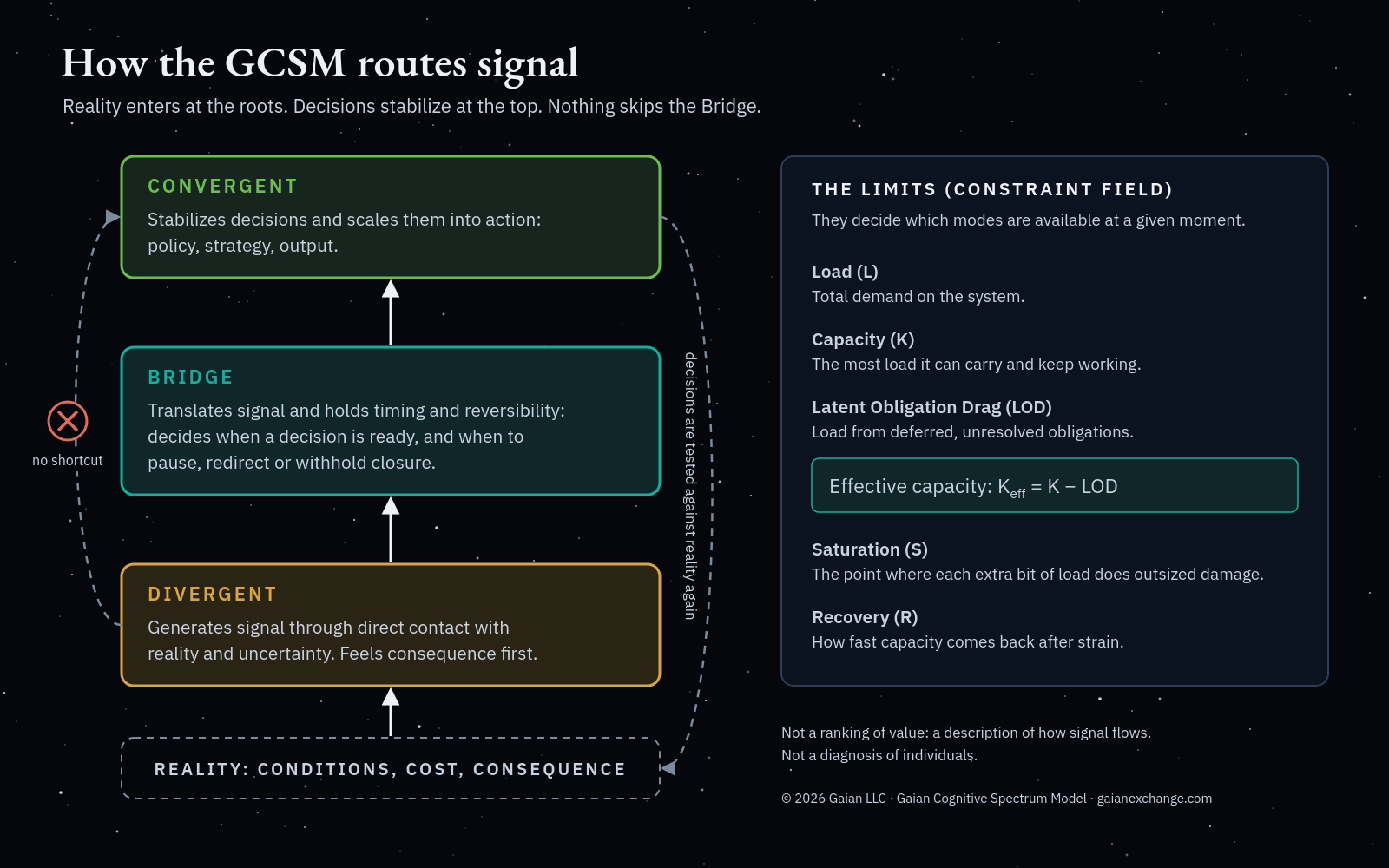
The model in six sentences
- Reality enters through divergence.
- Structure stabilizes through convergence.
- Transitions are governed by bridge.
- Constraints are enforced by load and energy.
- All observable behavior is expressed through condition-dependent branches.
- Correction remains available only as long as reversibility is preserved.
What it is not
The GCSM does not classify or diagnose individuals or groups, prescribe interventions, or make moral or political claims. Modes are not identities or personality types: no individual “has” a mode.
Working papers
These are working papers, not peer-reviewed publications. The official, dated copies are on OSF.
GCSM.WP.1v1: Foundation of the Gaian Cognitive Spectrum Model
December 8, 2025 · PDF · working paper
Defines the three cognition modes (Divergent, Bridge, Convergent), their structural roles, and the core routing constraints governing system behavior. Establishes the model as a non-diagnostic, non-moral framework centered on structure, cost-bearing, and mode interaction.
GCSM.WP.1v2: Refined structural formulation of the core model
February 4, 2026 · Word document · working paper
Clarifies geometry (inverted/standard cones), removes interpretive ambiguity, and formalizes routing boundaries between cognition modes. Introduces stricter constraints on transition legitimacy and eliminates misclassification of modes as traits or identities.
GCSM.WP.2v1: Failure in Time
February 5, 2026 · PDF · working paper
Analyzes how improper transitions between Divergent, Bridge, and Convergent modes accumulate over time, leading to instability, collapse, or extraction. Defines failure as a structural outcome independent of intent or competence.
GCSM.WP.3v2: The constraint interaction layer
March 25, 2026 · Word document · working paper
Formalizes how Load (L), Capacity (K), Saturation (S), Recovery (R), and Latent Obligation Drag (LOD) shape routing outcomes. Shows that path availability, transition viability, and stabilization depend on conditions rather than being freely selectable.
GCSM.WP.3v3: Routing under constraint, stabilized
March 25, 2026 · Word document · working paper
Refines the integration between the routing map and the constraint field into a unified execution model. Establishes the Condition Branch as the active expression of system state under pressure.
GCSM Intelligence WP v3: Intelligence and decision systems
March 24, 2026 · Word document · working paper
Examines how cognition modes and constraint conditions influence perception, interpretation, and response selection in complex environments. Frames intelligence as routing behavior under constraint rather than static capability.
Glossary
- Divergent cognition: generates signal through direct contact with reality and uncertainty.
- Bridge cognition: translates signal and governs timing, switching, and reversibility: when closure is legitimate, and when to pause, redirect, or withhold it.
- Convergent cognition: stabilizes decisions and scales them into action.
- Reality ingress: where signal from real conditions enters a system.
- Load (L): total demand on the system, including demand created by interventions.
- Capacity (K): the most load a system can carry while keeping its integrity. It changes over time.
- Latent Obligation Drag (LOD): capacity already committed to unresolved obligations.
- Effective capacity (Keff): K − LOD. The real limit for any decision about what a system can take on.
- Saturation (S): how close a system is to its capacity limit. Near it, each extra bit of load does outsized damage.
- Recovery rate (R): how fast capacity comes back after load is reduced.
- Switching cost (SC): the energy needed to change states. A change is possible only if SC ≤ Keff − L.
- Reversibility window: the range in which effects can still be undone without lasting penalty.
- Condition Branch: a temporary state that emerges from current conditions (load, energy, timing, coupling). It describes what a system can do right now, not what it is.
- Psychofunctional Delusion: a failure in which a system keeps producing rewarded output after losing contact with reality.
- Authority drift: decision authority moving away from the people who bear the cost.
How it relates to earlier work
The GCSM builds on a long line of research. In the manuscript’s own account:
- Cognitive load theory (Sweller, 1988; Paas, Renkl & Sweller, 2003) formalizes limits on working memory. The GCSM extends this to transitions between modes and to obligations that limit future capacity.
- Dual-process theories (Kahneman, 2011; Evans & Stanovich, 2013) distinguish fast and slow thinking. The GCSM asks where signal from reality enters, and how it is kept or lost across those processes.
- Unitary intelligence models (Spearman, 1904; Jensen, 1998) treat performance differences as individual ability. The GCSM treats them as structural conditions.
- Executive function research: the Bridge’s power to pause or withhold closure parallels inhibitory control (Miyake et al., 2000; Diamond, 2013), specified as a governance mechanism rather than an individual capacity.
- Information-processing models (Broadbent, 1958; Neisser, 1967): the GCSM’s direction of signal flow is consistent with them.
- Organizational failure and learning (Perrow, 1984; Reason, 1990; Weick, 1995; Argyris & Schön, 1978): the GCSM adds a single cognitive model linking individual processing, constraints, and reversibility.
- Resilience and thresholds (Holling, 1973; Walker et al., 2004; Scheffer et al., 2001): reversibility is a known critical property. The GCSM proposes ordered threshold classes for how it collapses.
- Mental workload (Hart & Staveland, 1988): Latent Obligation Drag extends workload accounts to deferred obligations.
- Method: structural-analytic modeling, in the tradition of Newell & Simon (1972), Simon (1969), Forrester (1968), and Meadows (2008).
Full references are in the manuscript.
Limits and open questions
- Not yet tested against data. The GCSM was developed through structural-analytic modeling. Its claims describe relationships between parts of a system, not numerical predictions. They are meant to be testable through studies in specific fields, and those studies have not been done yet.
- No standard units yet. Turning capacity, Latent Obligation Drag, and the threshold classes into measurable quantities needs calibration in each field.
- Still open: stating in advance which results would count against the model.
- Next steps: empirical calibration of threshold variables, measurement methods for the Condition Branch, and field-specific applications.
Tools
GCSM × USA Society, 3D map: an interactive view of the model applied to US society.
Gaian Cognitive Assessment: in development. Not a diagnostic or ranking tool. Early participants can help with the research.
Author: Jessica Sanchez · ORCID 0009-0008-5913-7788