
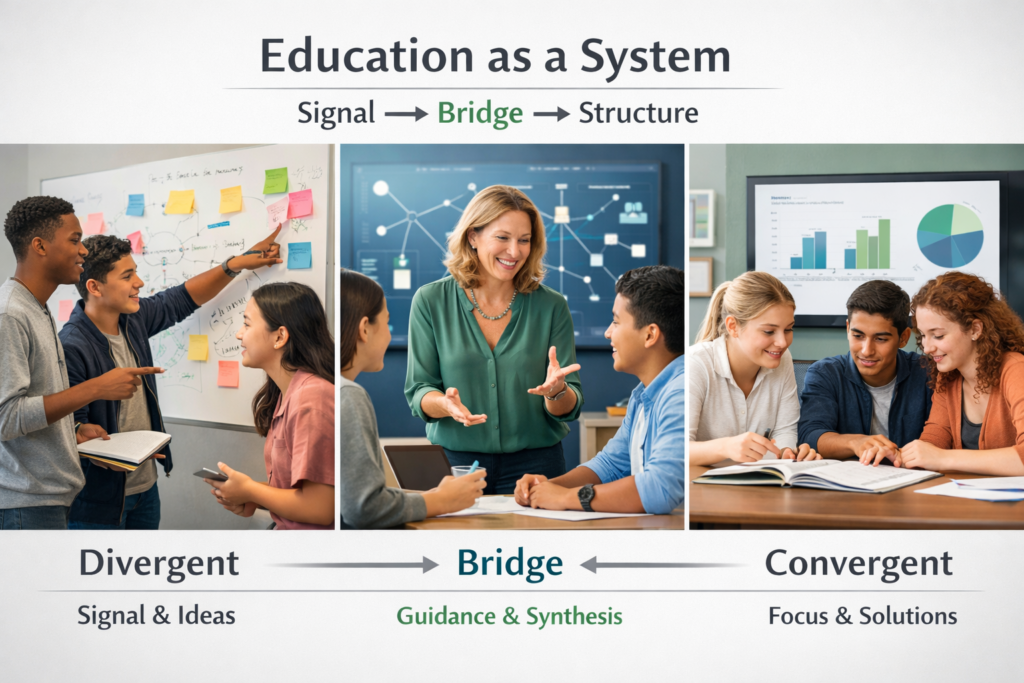
Most conversations about education start in the wrong place.
They assume the problem is:
- lack of funding
- outdated curriculum
- poor teaching methods
- disengaged students
These explanations are not incorrect. But they are incomplete.
They describe surface-level symptoms.
They do not explain why the system continues to produce the same outcomes, even when those variables are adjusted.
The Structural Problem
Education does not fail because people within it are incapable.
It fails because the system is structurally misaligned.
At a basic level, any learning system must coordinate three functions:
- Signal generation — how new understanding forms
- Stabilization — how knowledge is organized and applied
- Transition between the two — when learning should remain open vs when it should be formalized
In most education systems, the first and third functions are weak or suppressed.
The system overemphasizes stabilization.
What That Looks Like in Practice
Students are expected to:
- produce correct answers quickly
- follow predefined pathways
- demonstrate understanding in standardized formats
But learning does not begin with answers.
It begins with variation:
- confusion
- pattern recognition
- exploration
- partial understanding
When a system forces closure too early, it interrupts this process.
The result is not failure to learn.
It is interrupted signal formation.
Why This Pattern Persists
Education systems are designed for coordination.
They need:
- measurable outcomes
- comparable performance
- scalable evaluation
These are stabilization functions.
They are necessary.
But when they dominate the system, they begin to override the conditions required for learning to form in the first place.
This creates a cycle:
- Signals are suppressed or rushed
- Outputs become shallow or inconsistent
- The system increases control to correct this
- Signal formation is further reduced
The system responds to its own distortion by intensifying the cause of that distortion.
The Missing Function
What education lacks is not better content or more tools.
It lacks a governing mechanism that determines:
- when exploration should continue
- when structure should be introduced
- how to translate emerging understanding into stable knowledge without collapsing it prematurely
Without this function, systems default to one of two states:
- Premature structure → learning is shallow, rigid, and fragile
- Unstructured exploration → learning is inconsistent and difficult to apply
Neither state is stable on its own.
A Different Way to Understand the Problem
Instead of asking:
“How do we improve education?”
A more accurate question is:
“How do we align signal formation, coordination, and timing within the system?”
This reframes the issue completely.
It shifts the focus from:
- individuals → structure
- performance → process
- outcomes → alignment
What This Does Not Mean
This is not an argument for:
- removing standards
- eliminating structure
- abandoning evaluation
Stability and coordination are necessary.
The issue is not their presence.
It is their timing and dominance.
What Changes When the Structure Is Aligned
When learning systems maintain alignment:
- signals are allowed to form before being evaluated
- structure is introduced at the correct stage
- outputs reflect actual understanding, not forced compliance
- correction becomes less reactive and more precise
The system does not need to increase pressure to maintain performance.
It becomes more stable with less force.
Final Thought
Education is often treated as a problem of improvement.
In reality, it is a problem of structure.
Until the relationship between learning, coordination, and timing is addressed, reforms will continue to cycle without resolving the underlying issue.